 | ||
|
| ||
THE HIBERNIAN MYSTERIES
Category - Atlantis, Agriculture, Ireland, Biodynamics (Angelic Engineering - Intelligent Design), Gardening
By LA. Rotheraine
Editor's Note: This article is a continuation of The Hibernian Mysteries as a Foundation of Biodynamics which appeared in Biodynamics , No. 181, Winter 1991-92. With bold and somewhat experimental strokes, Mr. Rotheraine has tried to describe the biodynamic method as an active path of initiation, one that can lead agriculture back again into nature's house. Mr. Rotheraine's style and language may seem too mystical, alchemical, and religious for some readers, but the idea of biodynamics as a path of transformation is worth considering. His source material Mystery, Knowledge and Mystery Centers (23 November to 23 December 1923) is one of Steiner's greatest meditations concerning nature and the human being.
|
If mankind with their present state of knowledge were suddenly obliged to create, from the comparatively few plants of the primeval epoch of the earth, the manifold variety of our present fruits and fruit trees, they would not get very far. We should not get far if it were not for the fact that the forms of our different fruits are inherited. They were produced at a time when humanity had knowledge, out of primeval and instinctive wisdom, how to create the different kinds of fruits from the primitive varieties that then existed. If we did not already possess the different kinds of fruit, handing them down by heredity if we had to do it all over again with our present cleverness we should not be very successful in creating the different kinds of fruit. Nowadays it is all done by blind experiment, there is no rational penetration into the process.... We must gain new knowledge in order to enter again into the whole Nature relationship of these things. Mankind has no other choice. Either we must learn once more, in all domains of life learn from the whole nexus of Nature and the Universe or else we must see Nature and withal the life of Man himself degenerate and die. As in ancient times, it was necessary for men to have knowledge entering into the inwardness of Nature, so do we now stand in need of such knowledge once again. Rudolf Steiner, Agriculture |
 |
My previous article in Biodynamics No. 181 tried to show how biodynamics is a continuation of the Hibernian Mysteries mysteries and how the biodynamic preparations give to humanity the tools to unite the earth's past with its future through the human being. I intimated that earthly processes are like a condensation or coagulation of cosmic processes, in the same way that a seed condenses the gravitational earthly tendency and the light born levitational tendency, or in the human soul the microcosm of thoughts condenses the macrocosm of external nature. In addition, the effect of this, our internal weather through our thoughts can bring about rightful changes on the earth through the biodynamic preparations. The biodynamic preparations allow us to rediscover and uncover the workings of cosmic processes. In working with the preparations, the human kingdom becomes a spiritual agent in the process of creation instead of its destroyer.
The Hibernians learned Nature's secrets through what Steiner termed a winter experience and a summer experience. They learned to see life (summer-future) and death (winter-past) as one continuous process in the human soul. Heracitus famous phrase, Living and dead are the same.
... The one on changing becomes the other, the other in changing becomes the one, was perceived by the Irish initiates thousands of years before this spark of wisdom ignited a picture of this reality in Heraclitus soul.
|
The pupils were compelled to experience every doubt, every torment, every inner struggle with its frequent aberrations, being deceived by no matter how excellent logic or dialectic all this they had to endure and experience the difficulties that make themselves felt when one has actually attained knowledge and wishes to bring it to expression.... The pupil was made acquainted with experience undergone only by one who has valiantly and genuinely struggled to attain knowledge. Secondly, the pupil was led to experience in his life of soul how little everything that may become knowledge on the ordinary path of consciousness can, in the last resort, conduce to human happiness, how little human happiness can be promoted by logic, dialectic or rhetoric.... He had already been so deeply initiated into the doubts and difficulties connected with the attainment of knowledge that when at last he was guided from these preparatory stages to the actual approach to the cosmic secrets, he had come to this resolution: if it need be, I will forgo even knowledge: I will deny myself everything that cannot contribute to human happiness. Rudolf Steiner, Mystery Knowledge and Mystery Centers,
23 November to 23 December 1923. R. Steiner Press, London |
The pupil was now ready for higher knowledge and to learn of the approach of the Cosmic Word, the Cosmic Secret. We can call the next two stages and their accompanying thoughts and feelings the 501 experience and the 500 experience.
In the winter experience 501 in our context the pupil was confronted by a male statue. Dr. Steiner states:
|
One pillar-statue, the male figure, was made of a substance that was elastic throughout. It could be indented anywhere by pressure. The pupils were exhorted to press and so make indents all over this statue. This revealed that it was inwardly hollow. It was really only the skin of a statue, but made of an elastic material so that wherever it was indented the form was immediately restored. Above this statue, above its head, which seemed to be particularly characteristic of the whole figure, was something which seemed to resemble the Sun. The whole head was of such a nature that the pupils could see it was meant to be something like an eye of the soul; as such it was intended to be a microcosmic representation of the whole Macrocosm. This manifestation of the Macrocosm was meant to be expressed in this colossal head by the Sun. The immediate impression given by the male statue was this: the Macrocosm works through the Sun and fashions the human head which has knowledge of the impulses of the Macrocosm and forms itself inwardly and outwardly in accordance with these macrocosmic impulses. Ibid. |
In the 500 summer experience the pupil was confronted by a female statue. Dr. Steiner states:
|
In the case of the other statue, the pupil's eyes fell, to begin with, upon something that seemed to be composed of luminous bodies radiating inwards, and in this framework the pupil saw a female form which was everywhere under the influence of these rays. And the feeling came to him that the head was produced out of the rays. The form of the head itself was somewhat indistinct. This statue was composed of a different material; it was plastic, not elastic, and extremely soft. The pupil was exhorted to press this statue too. Wherever he pressed it, the indent remained. Each time the pupil was tested before these statues, the pressure marks he had made were repaired before the next test. So that whenever the pupils were taken to the ceremony in front of this statue, it was again intact. The statue made of elastic substance always returned of itself to its original form. With the second statue the impression was received that it was entirely under the influence of the Moon-forces which permeate the organism and enable the head to emerge. These experiences made a most profound impression upon the pupils. And now, when the effects of this were inwardly experienced by the pupils, cosmic secrets relating to the Microcosm and the Macrocosm were expounded to them.... The result of the stupendous inner deepening experienced and endured by the individual pupil was that he was led to the threshold of the spiritual world. |
Steiner then continues with the winter soul metamorphosis of the pupil; continues what I call the 501 experience.
What the pupil experienced to begin with when he gave himself up to the impressions of the male statue, was a kind of numbness, a rigid numbness of the soul which set in with greater and greater intensity.... Then he felt that what was numb and frozen--namely, he himself-- was being taken up into the Cosmic All. He felt as if he were being transported into the wide spaces of the Cosmos. And he could say to himself: The Cosmos is taking me into itself!... The rays of the Sun and the Stars are drawing me out into the Cosmic All, but nevertheless I remain here, within my own being.... When this experience has lasted for the necessaiy length of time, a remarkable vista came before the pupil. Now for the first time he realized the purpose of this state of consciousness which had set in during the numbness. For now, through his various experiences and their echoes, manifold impressions of winter landscapes came to him. Winter landscapes were there in the spirit before him, landscapes in which he saw whirling snowflakes filling the air--as I said, it was all seen in the spirit--or landscapes in which he gazed at forests with snow weighing down the branches of the trees, or similar sights, always reminiscent of what he had seen here or there in his everyday life, and always giving the impression of reality. After he had been transported into the Cosmic All he felt as if his own consciousness was conjuring before him long wanderings in Time through winter landscapes. And during this experience he felt as though he were not actually in his body, but certainly in his sense-organs; he felt that he was living with the whole of his being in his eyes, in his ears, also on the surface of his skin. And then, when his whole sense of feeling and of touch seemed to be spread over his skin, he also felt: I have become like the elastic, but hollow, statue. Ibid. |

Steiner also continues with the 500 summer soul-metamorphosis of the pupil:
|
Then he was brought to the point where his experiences with the plastic not the elastic statue could echo within him. And now he was not overwhelmed by inner numbness but by inner heat, by a feverish condition of the soul, accompanied at first by bodily symptoms. The pupil was aware of greater inner pressure; he felt as though both breath and blood were exerting too great a pressure and he became aware of a deep, inner need. And in this state the second experience he must undergo became clear to him. Born from the need felt by his soul, the realization that came to him and of which he was intensely conscious, might be clothed in the following words: I bear within me something that my bodily nature demands in ordinary earthly life. This must be overcome. My Earth-Ego must be overcome! Then, when the experience of this inner fever, this need of soul, this feeling that the earthly Ego must be overcome, had lasted for the necessary length of time, something arose in the pupil of which he knew that it was not the previous, unfamiliar state of consciousness but that it was a state well known to him, namely, the dream consciousness. Whereas from the earlier numbness had come the distinct feeling that he was in a state of consciousness unknown to him in ordinary life, he knew now that his consciousness was a kind of dreaming. He dreamed; but in contrast with his earlier consciousness although again in harmony with what he had experienced he had dreams of the most wonderful summer landscapes. But he now knew that these were dreams, dreams which filled him with intense joy or with intense suffering, depending upon whether what came to him from the summer was sad or joyful, but in either case with the intensity of feeling accompanying dreams. At the same time the pupil knew that what was in his consciousness, in a state of continual transformation like an enchanted summer, was indicative of impulses leading over to the Future of the Cosmos. But now he did not feel as though he were scattered into his senses and multiplied. On the contrary, he felt inwardly gathered into a unity. Ibid. |
The winter experience consisted of the expansion of the soul into the far limits of the cosmic ether the limits of the macrocosm. A frozen numbness pervaded the Hibemian as his ego fragmented into his nerve sense system. And in this state of numbing cold he felt as Steiner states:
|
In my mystely winter wanderings I have experienced what is Past in the Cosmos. The snow and ice in my enchanted winter have revealed to me death bringing forces and impulses of destuction in the Cosmos. And my numbness on the way to those Mystety-winter wanderings was the intimation that I was to behold forces in the Cosmos which came over from the Past into the Present but in the Present are dead cosmic forces.... Ibid. |
At the height of his twelvefold ego fragmentation in the winter experience a transformation to the summer experience transpired. Steiner states:
|
...But now he did not feel as though he were scattered into his senses and multiplied (winter experience). On the contrary, he felt gathered into a unity; he felt held together in his heart. The culmination of the summer experience was the sense of being held together in his heart, this feeling of inner union with the dream of summer--not with the summer as outwardly seen (in the spirit). And rightly the pupil said to himself: In what the dream of summer reveals and I experience in my own being, therein lies the future... ...But through initiation we know that the spirit is all the time dying in matter, announcing this in freezing, benumbed Nature. A void is continually being produced. And out of this void something is born, something resembling to begin with, the dreams of Nature. And the dreams of Nature contain the seeds of the Cosmic Future. But Cosmic Death and Cosmic Birth would not meet if Man were not there in the middle. Ibid. |
The best way I can think of to express the transition from the winter experience of the Irish initiate to that of summer is to observe a withering garlic clove. A void is created in the center of the clove, out of which sprouts the future plant. Picture the old clove as lifeless substance now in its dying winter. A new picture arises in its death from out of the cosmos. The fragmentation of the original clove begins at the organism's peripheiy, while in a void at the center a unity of cosmic forces gathers itself together for a future summer life. Imagine the clove as the Hibemian's physical body in which his soul and spirit recapitulate the life (future- summer) and death (winter-past) process of himself and the Earth.
The Irish student could now perceive seeds as frozen thoughts of cosmic dream pictures that would have to be awakened to new pictures in the spring. Through the chaotic void in the seed could be born the cosmic dream of the following (future) summer. Just as what the Hibernian learned of cosmic past and future find their existence in man, so he could perceive a microcosm of his enlightenment recapitulated in the seeds of the plant kingdom. As the individual soul and spirit of the Hibernian reached the limits of fragmentation into a twelvefold ego in the winter experience and a coming together in a unity at a specific moment in the summer experience, so he could perceive the intimate workings of the group souls and spirits in the plant and animal kingdoms in these higher worlds.
The Hibernian learned how the death of spirit works in the production of earthly substances. He learned that the forces of death are necessary for the production of earthly substances and how cosmic processes enliven and resurrect death in these kingdoms. In the resurrecting Sun forces he saw the Being of the Sun on his journey to earth, directing, orchestrating, gathering together the beings that are humanity's spiritual companions and co-workers. He learned how they work into the earth organism itself, work for the resurrection of the earth through the human being. And in seeing the Sun King and the sun beings he beheld the Logos-Life of the World, the Cosmic Word. Whereas before initiation he saw sunbeams as providing nourishment for the earth, now he saw that the beams were in actuality beings. And enhanced with this natural spiritual science from the Irish Wisdom, he was no longer enchanted by dead earthly thought but could place himself in the living Cosmos where living thought creates life. He could place himself in the frozen thought that in it's death has become soil, and bring it to life again. The Hibernian became an expert in the secrets of vegetation and its growth, and the life forces that create and maintain animals. The Hibemian became the steward and good shepard of the plant and animal kingdoms on earth. He saw in death a microcosm of his own spiritual withdrawal from the physical body the winter experience. And from the accumulation of the residues of death the metamorphosis of life (summer), the gathering together and earthly growth of life forces for future life. He now knew from his experiences of the past and future what we learn from the Agriculture Course Steiner gave at Count Keyserlingk's in June 1924:
|
Say we plant the seed of some plant in the Earth. Here in this seed we have the stamp or impress of the whole Cosmos from one cosmic aspect or another. The constellation takes effect in the seed; thereby it receives its special form. Now, the moment it is planted in the Earth-realm, the external forces of the Earth influence it veiy strongly, and it is permeated every moment with a longing to deny the cosmic process that is to say to grow hyperirophied, to grow hypertrophied (divided) to grow out in the all manner of directions. What is working above the Earth does not want to perceive its form.... The seed must be driven to the state of chaos. On the other hand, when the first beginnings of the plant are unfolding out of the seeds, and at the later stages also-over against the cosmic form which is living as the plant-form in the seed, we need to bring the earthly element into the plant. We must bring the plant nearer to the Earth in its growth. And this we can only do by bringing into the life such as is already present on the Earth. That is to say, we must bring into it life that has not yet reached the utterly chaotic state life that has not yet gone forward to the stage of seed-formation life, that is to say, which came to an end in the organization of some plant before it reached the point of seed formation. |
It is to help the spiritual world create that we use horn manure 500. Now, from the Hibernian perspective, what goes on in horn manure 500? Imagine yourself in the horn. A dark, quiet warmth pervades its internal weather when it is first placed in the ground. Slowly, plant forms as archetypes, as Steiner states, begin to enter the horn, always working from the outer periphery to the center. Slowly, as the winter progresses, the archetypes of the earth (the plant images arising from archetypes) continue to penetrate the manure, impressing their living being into the manure. The feeling is one of moisture, warmth, compression and unity.
With each archetype, the energy from the idea contributes to the transformation of the substance. Warmth filled pictures dominate the being of the meditative observer. Ironically, the winter experience in the horn becomes a microcosm of the summer experience of the Hibernian soul the contraction of soul in the heart of the Hibernian. The farmer becomes a vehicle for the female principle of plant fertilization to transpire vis-a-vis the impress of Earthly thought. The human being then rhythmically implants these pictures in water and gives them back to the earth when the preparations are sprayed over the fields.
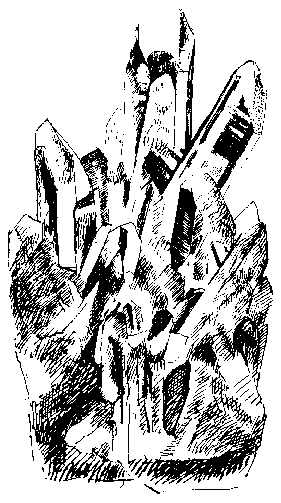
Inside the horn with 501 is the opposite experience of 500. One gets the feeling of instreaming light immediately penetrating the horn rather than having the slow impressing, the centering of forces as in the horn of 500. Inside the horn, one feels as if one is in an expansive outstream of light, floating in rising currents in the horn to meet the cosmic light filled archetypes not raying to the center of the horn but outstreaming to the periphery a microcosm in many ways, of the winter experience. From the horn's periphery an expansive meeting occurs between the instreaming Cosmic thought and the outstreaming crystals. Again a transformation takes place, but it is more a give and take between the crystals in the horn and the cosmic forces that create this transformation. Again, man becomes the vehicle for past and future to work on earth when he adds this perceiving and distributive substance to water and sprays it on the plants.
Thus, we create a thought organ in 500 to capture the secrets of the earth in winter as a microcosmic summer experience takes place in the horn; this, to enhance the earthly, female principle in the soil. The human being then places this living future into the dead thoughts (soil) that we are going to plant into, in the spring. We give the future to the past (substance, mass and quantity) life to what is dead by using 500 (or the B.D. Compost Starter). The transformed substance from the grave of the horn resurrects life through the human being.
L.A. Rotheraine is a writer, lecturer and award winning biodynamic gardener in Bradford, PA.
Copyright 1993 L.A. Rotheraine
First printed in Biodynamic Journal